Artificial intelligence has significantly transformed the film and advertising industries in recent years. From concept development and screenwriting to visual effects and voice adaptation, it accelerates workflows, enhances results, and unlocks new creative possibilities.
This article provides an overview of the practical applications of AI across the different stages of production. Following the pre-production phase, the focus shifts to voice and visual applications in the production and post-production of films, as well as the specific use cases of AI in the advertising industry.
Pre- Production
Screenwriting and Casting
The screenplay is the foundation of every film. Building this foundation as strongly as possible requires several rounds of editing and checking for logical consistency.
With the help of AI, this process can be significantly accelerated. It can also introduce a new level to the workflow, with an LLM reviewing the screenplay for logical errors and checking the use of language. This can be particularly helpful for passages in a foreign language or when using archaic language.
AI can also support the casting process by analyzing actors’ previous roles. It analyzes the range of characters they have already portrayed and compares these with the requirements of the advertised role in order to assess who best fits the role being sought.
Storyboarding
Storyboarding transitions from the textual aspect to the visual one. The written scenes are sketched digitally or by hand to develop a sense of how they can be visually realized. It serves as a guide for the camera and direction, while also providing the opportunity to experiment with different shots without much effort.
Text-to-image AI models accelerate this process and therefore make it possible to review and consider more options to find the best possible shots for the final product.
Production and Post Production
De-Aging and Aging
It is nothing new to digitally de-age or age actors for specific roles. CGI processes are normally used to achieve this. Scanning the actor’s face helps create a digital 3D model. Muscles, blood flow, and skin features such as small hairs are then created for this model. During the rigging process, the team ensures that the entire construct moves naturally. This process takes place in post-production and is extremely time consuming.
Another fundamental problem with de-aging is that the actor’s body language does not necessarily match their younger version. One example of this is Robert De Niro in “The Irishman” (2019). Even though his face has been de-aged and looks convincing, some of his movements appear too slow and do not correspond to the intended age.
When it comes to aging, there is the option of using prosthetics. The problem with this is that they can look artificial and may not move naturally like skin, but rather like rubber.
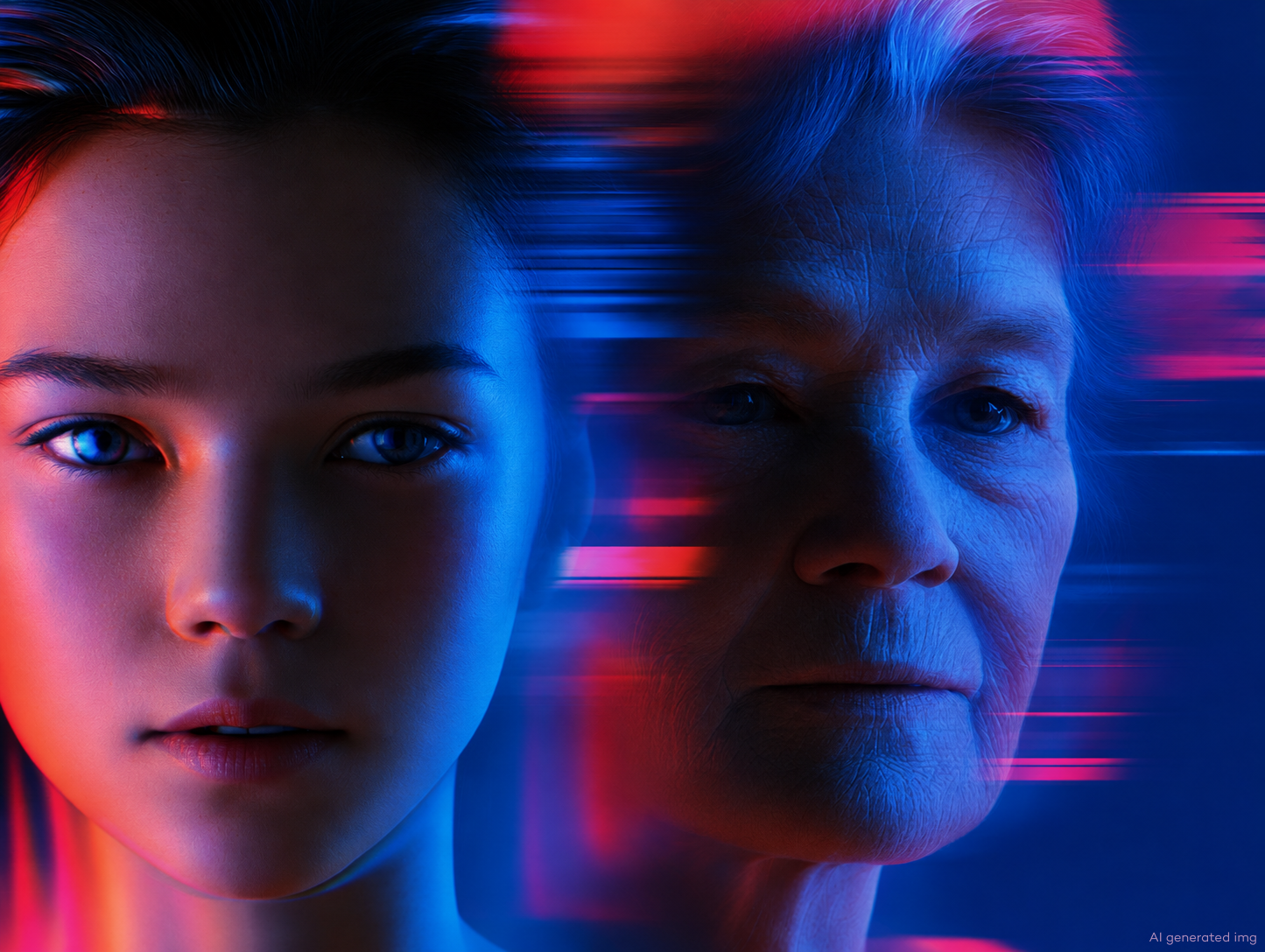
The production team behind the film “Here” (2024) had to deal with both problems. The drama tells the stories of several generations of a family over the course of decades, all from a single camera shot. In doing so, the actors were both de-aged and aged. To make this process as efficient as possible, the team decided against the usual CGI processes. Instead, it trained an ML system together with Metaphysics using a series of images of the respective actor. For this purpose, it created image sets showing the person in different situations, perspectives, and lighting conditions. When the generative AI was subsequently tasked with creating a digital younger double, it generated a completely new image based on the supplied images. Once the AI had been trained, this happened within seconds. This made it possible to see a live face swap on a second monitor on set. The problem of movements not matching the age being portrayed could also be addressed more effectively, as the crew could immediately see whether the actor’s posture and gestures matched the face-swap face. The team then made more precise adjustments to the lighting and colors during post-production.
The process is somewhat different when it comes to aging, as there are no images of the actors from the future. Therefore, photos of the actors wearing prosthetics that make them look older were used as input for the AI. The AI then makes the movements of the prosthetics appear smoother and more natural.
The Baby Problem
Twilight fans will probably remember the uncanny baby from “Breaking Dawn – Part 2” with horror. Everyone else, who was spared the sight, has probably seen far better versions of digital babies in recent years. Even though it is a completely digitally created “object” that does not rely on natural human movements, as is the case with aging or de-aging, there have at least been significant advances in the area of facial expressions.
A combination of CGI animation and ML by Revize, for example, brings Baby Thor to life in “Thor: Love and Thunder” (2022). The difference compared to the Twilight baby is the use of machine learning, which makes the animated model look more human based on a series of images of a real baby, similar to the process used for aging and de-aging. By training the AI with these images, Baby Thor appears much more human and far less uncanny compared to the Twilight baby.
Will CGI be replaced by AI Models?
Probably not. At least not next week. While the future is always unpredictable and AI is developing so rapidly that there are almost daily new and improved models, CGI has the advantage of giving you full control over the object being created. The process is long and tedious, but whenever an exact template needs to be implemented, CGI is the safer choice.
Voices and Language
AI is also used for language in various ways. This ranges from foreign languages and dubbing to making text changes after filming.
Accents and Dubbing
In the drama “The Brutalist” (2024), the film team uses Respeecher in post-production to improve the Hungarian accents of the two lead actors for a more authentic result.
AI tools also make dubbing films and series easier, as they can adapt the actors’ lip movements to the new language, resulting in a convincingly realistic outcome. In this case, the process is also referred to as vubbing, or visual dubbing. Flawless, for example, achieves exactly this with its AI tool “TrueSync.” All the production team needs to provide is the master version of the film and the dubbing files. TrueSync adapts the lip movements without reconstructing the actor’s entire face, thereby preserving the original expressions. After a quality check, the team delivers the finished product to the respective film production through Flawless’ professional localization partners.
**** you!
Sometimes it simply slips out during filming, and in the blink of an eye, the planned PG-13 film ends up with an R rating instead. This was the case with the action comedy “Playdate” (2025), for example. To still get the film a PG-13 rating without having to reshoot all the affected scenes, the production teamed up with Flawless. With Flawless’ “Censorship Editing,” the film can be brought back to a PG-13 rating in five steps. First, the film team writes new dialogue. The actors then record the new lines.
| Original | Adjusted |
| „get f***ed up“ | „get ripped up“ |
| „F*** yeah dude!“ | „Hell yeah dude!“ |
| „he calls me a f***nose bitch” | „he calls me a bucktooth bitch” |
The newly recorded dialogue is then uploaded to “DeepEditor,” one of the company’s core vubbing tools. This creates a new profanity-free scene that is convincing not only linguistically but also visually, without having to reshoot the entire scene.
Time Travel
Some may still remember the little red haired goblin Pumuckl and Master Eder. The cult series from the 1960s was rebooted in 2023. For this new version, Respeecher used AI to revive the original voice of Pumuckl, Hans Clarin, to recreate the emotional connection between Pumuckl and the audience.
After receiving approval from Clarin’s family, archival recordings from the original series were used to train the AI. The team then continued the training in close collaboration with the series production company Neuesuper until the results were authentic and expressive. A new actor provided the voice for Pumuckl, which Respeecher’s trained AI then transformed so that it sounded like Clarin’s original voice from the past.
AI in Advertising Production
While the film industry primarily uses AI for spectacular storytelling, the advertising industry is all about data, speed, and targeted communication. Here, too, the use of AI supports the creative process:
Pre-Production
In concept development, AI analyzes target audience trends and customer data within seconds. Tools such as ChatGPT or Jasper create initial scripts, storyboards, and text versions.
To launch the luxury sedan Lexus ES, Lexus used ML to create the core script, narrative structure, and dramatic arc of the commercial. To develop this customized AI, Lexus worked with the creative agency The&Partnership London and technical specialist Visual Voice, using IBM Watson technology. The AI was trained on 15 years of award-winning luxury car commercials from the Cannes Lions, combined with data on emotional responses from the video marketplace Unruly and studies on human intuition conducted by MindX, the applied science division of the University of New South Wales. To bring the resulting script to life, Lexus worked with Oscar-winning director Kevin Macdonald, who directed the story of a Takumi craftsman whose creation saves itself using an automatic emergency braking function.
Production
When creating visual assets, image and video generators such as Midjourney, DALL-E, or Runway save a massive amount of time and open up new creative approaches.
With its award-winning “A.I. Ketchup” campaign, Heinz impressively demonstrated how a marketing team can use artificial intelligence in a playful and effective way for brand management. In collaboration with the creative agency Rethink, the brand fed the then-leading text-to-image generator DALL-E 2 with generic terms such as “Ketchup,” “Renaissance Ketchup Bottle,” or “Ketchup Tarot Card.” The results showed that even the AI associated the word “ketchup” with the iconic Heinz bottle almost without exception.
Through social media, Heinz involved the community by allowing users to submit their own image ideas, which were then generated. In addition to the digital collaboration, special editions of physical Heinz bottles featuring the AI-generated labels were produced, along with a dedicated art gallery in the metaverse.
Post-Production & Distribution
Tools such as Runway Gen-2 or Adobe Sensei automate time-consuming tasks such as removing distracting objects or unwanted blemishes. AI-powered reframing from 16:9 to 9:16 for social media stories saves time and eliminates the need for manual editing of the material, ensuring the effective distribution of advertising across a wide range of channels.
As already mentioned in the section on language in film post-production, the same processes can naturally also be applied to advertising. In particular, translating content into different languages becomes more efficient, opening up or catering to new markets.
AI has long since become an integral and highly valuable part of modern film and advertising production. Whether it is scripts, de-aging, dubbing, editing, or subsequent dialogue changes, the technology provides solutions to problems that were previously either impossible to solve or could only be addressed with enormous effort. A failed take no longer necessarily requires an entire reshoot, an age discrepancy between an actor and their role can be convincingly bridged, and even the voices of deceased or unavailable actors can continue to live on respectfully with the consent of those involved.
This is precisely where the great potential of these modern technologies lies. They provide creative professionals with new tools that make it possible to realize visions that previously would have failed due to budget, time, or technical limitations. The development is rapid, and with each passing month, the results become more convincing.
AI does not take over the creative vision; instead, it expands the toolbox of everyone involved with possibilities that enrich film and advertising. The future, therefore, will not be determined by AI or humans alone, but by both working together.