
Driving in the Future: Balancing Safety, Engagement, and Emotion
Driving is evolving at the intersection of technology, safety, and user experience. Augmented Reality (AR) is transforming the way we interact with our vehicles, overlaying digital guidance, hazard alerts, and playful cues directly onto the road ahead. Beyond navigation, AR enhances situational awareness, reduces stress, and turns everyday driving into a more intuitive, engaging experience. From AI-powered HUDs (Head-Up Displays) to gaming-inspired interfaces, the future of automotive UX is about blending utility with emotion, making every journey smarter, safer, and more enjoyable.
What Is Augmented Reality (AR)?
Augmented Reality (AR) is a technology that enriches the physical world by overlaying digital information, such as 3D objects, text labels, or visual cues, directly onto what we see. AR enhances the environment while keeping the user grounded in their real surroundings. This is making AR particularly valuable in driving scenarios where situational awareness is essential.
In simple terms, AR blends digital content with real-world perception in real-time. The goal is not to distract but to inform: to deliver contextually relevant information at the right moment and in the right place.
How Does Augmented Reality (AR) Work?
AR relies on a set of interconnected technologies that continuously interpret the environment and render digital content aligned to the physical world:
- Sensors & Cameras – capture visual, spatial, and motion data
- Computer Vision Algorithms, especially SLAM (Simultaneous Localization and Mapping) – maps surroundings and tracks device or vehicle position
- Rendering Engine – places 2D or 3D digital overlays at correct depth, size, and orientation
- Calibration & Alignment – ensures virtual objects stay locked to real-world surfaces even as the user or vehicle moves
Considering the automotive context, these elements are all operating under tight constraints such as highspeed, changing light, vibration, and weather conditions as well as complex traffic environments.
Types of Augmented Reality (AR)
Modern AR systems typically fall into three categories:
- See-Through Displays – head-up displays (HUDs), smart glasses. These project digital cues onto a transparent surface, useful when driving because the environment remains visible beneath overlays
- Video See-Through AR – smartphone AR, center-console camera views. These are showing a live video feed augmented with digital elements
- Projection-Based AR – projects graphics directly onto physical surfaces (dashboard, road boundaries, parking lines)
What we normally see in automotive is a combination of these elements designed to create a seamless in-cabin and windshield experience.
UX & safety challenges
Because AR inserts information directly into the user’s field of view, design quality is critical – especially behind the wheel. Key challenges include:
- Avoiding Distraction – too much data or flashy visuals can overwhelm drivers
- Managing Latency – even a slight lag between real-world motion and digital overlay can break immersion or cause misinterpretation
- Maintaining Spatial Accuracy – misaligned arrows or drifting objects reduces trust and may create safety risks
- Balancing Utility vs. Novelty – AR should be helpful, not gimmicky, particularly within a car
Automotive AR therefore requires rigorous testing, careful visual design, and strict compliance with safety standards.
Augmented Reality (AR) in the Automotive Industry
Augmented Reality has moved from an experimental concept to a core component of modern automotive UX. Automakers are no longer asking whether to integrate AR, but how to do it safely, meaningfully, and on a scale. Today, the conversation is increasingly centered on AI-enhanced AR, where Large Language Models and machine learning systems act as semantic “co-pilots,” enriching the visual layer with intelligence.
Why AR matters for automotive UX
From a user-experience perspective, driving involves three fundamentals: perception, attention, and decision-making. AR can support all three when designed responsibly. A UX-centric automotive AR system must balance functionality with safety. The challenge is ensuring AR feels like support, not a distraction.

Image created with MidJourney.
| Advantages | Risks |
| Clarify complex driving situations (navigation, lane selection, roundabouts). | Driver attention management: AR must simplify tasks, not add complexity. |
| Highlight potential hazards earlier than the driver might. | Content prioritization: AI can help determine when to show, what to show, and who to show it to. |
| Reduce cognitive friction by removing unnecessary information searches. | FOV discipline: too many POIs or markers overwhelm the driver’s field of view. |
| Create continuous, intuitive information flow across windshield, dashboard, and cabin. | Trust: misaligned or inaccurate AR destroys credibility instantly. |
| Overlays feel anchored to real-world motion, making guidance feel seamless and trustworthy during fast maneuvers. | Latency: overlays must respond within milliseconds to remain believable. |
| Adapt explanations and insights into the situation, the driver’s intent, and the environment, reducing confusion and improving decision-making. | Contextual correctness: LLM-generated explanations must avoid hallucinations or incorrect guidance. |
The role of AI and LLMs in next-generation automotive AR
Several 2025 studies illustrate how rapid AR for vehicles is evolving, suggesting that AR is moving beyond simple “overlay” features toward context-aware systems powered by vision models, multimodal AI, and LLM-based reasoning. Some examples:
- SEER-VAR (2025) – a new AR framework combining real-time vision processing with large language models to generate context-aware overlays: hazard cues, dashboard instructions, semantic scene understanding
- Augmented Journeys Study (2025) – introduces in-car AR experiences for passengers to explore points of interest (POIs) outside the vehicle using eye-gaze and gesture controls
- World-Fixed AR Visualization Guidelines (2025) – provides principles for rendering distant POIs in automotive AR without cluttering the view – critical for safe, readable interface design
SEER-VAR example
This recent study, supported also by Meta, introduces a dual-pipeline system that merges real-time SLAM with an LLM-based reasoner – showcasing a shift from graphic overlays to AI-powered cognitive augmentation. In short, SEER-VAR1 uses a GPT-powered recommendation engine to decide what AR information to show in a car and where to place it, so it feels meaningful and well-anchored in the real world.
The system looks at 3 things together: inside-the-car images (e.g., dashboard, driver view), outside-the-car images(road, surroundings), and vehicle status data like fuel level, speed, driving time, or dashboard visibility.
When certain events happen – such as the fuel getting low or the navigation system reinitializing – the GPT agent is triggered. It’s given a structured set of questions to reason through the situation:
- What environment is the car currently in?
- What is the vehicle or driver status?
- What AR information would be useful right now?
- Where in the scene should that information be placed?
Using this reasoning chain, the model outputs:
- Which AR elements to display (e.g., navigation cues, parking prompts, dashboard highlights, service suggestions)
- Exactly where to anchor them in both interior and exterior views, by predicting bounding boxes in the image
Sum-up of key capabilities enabled by AI + AR
- Semantic scene understanding – identifying pedestrians, signage, or risks and turning them into meaningful visual cues
- LLM-driven recommendations – the system can explain hazards (“Cyclist approaching from the right”), generate alerts, or adapt the interface based on user behavior
- Adaptive UI – overlays change based on weather, road complexity, or driver stress levels
- Natural-language interaction: drivers or passengers can use voice commands, like for example asking: “What is that building?” or “How do I park here safely?” and receive contextual AR guidance
The hidden layer: data as the foundation of automotive AR
Behind every AR cue projected onto a windshield lies a complex data pipeline. Modern automotive AR depends on millions of labeled images, high-resolution 3D maps, sensor fusion datasets, and continuously logged driving scenarios.
Computer vision models must learn to recognize lane boundaries, vehicles, pedestrians, and subtle environmental cues across weather, lighting, and regional variations – an effort that is only possible through large-scale, high-quality data labeling. At the same time, multimodal AI systems rely on structured vehicle data such as speed, trajectory, and telemetry to reason about what information should appear and when. As AR evolves from simple visual overlays to intelligent, context-aware copilots, the real differentiator becomes the quality of the data behind the scenes: how well it’s collected, annotated, validated, and fed back into training cycles. In practice, the clarity, accuracy, and safety of the AR experience are only as strong as the data powering it.
How to Create Intuitive Augmented Reality (AR) Driving Experiences?
Automotive UX is progressively incorporating gaming-inspired interaction models to improve engagement and manage driver stress. AR navigation and hazard overlays draw inspiration from gaming to create clearer, more supportive driving experiences.
Dynamic arrows appear directly on the real road to indicate upcoming turns, lane boundaries become visually reinforced in poor weather, and cyclists or fast-approaching vehicles are highlighted through semantic AI. Together, these elements merge traditional driver-assistance with a subtle layer of visual storytelling, enhancing guidance while reducing uncertainty.
AR parking assistance – where UX meets gamification
Parking scenarios represent a strong opportunity for introducing AR elements that are both useful and lightly playful. Parking has long been a source of stress for drivers, but AR can transform it into a smoother, almost effortless experience by combining clear visual guidance with subtle game-inspired feedback.
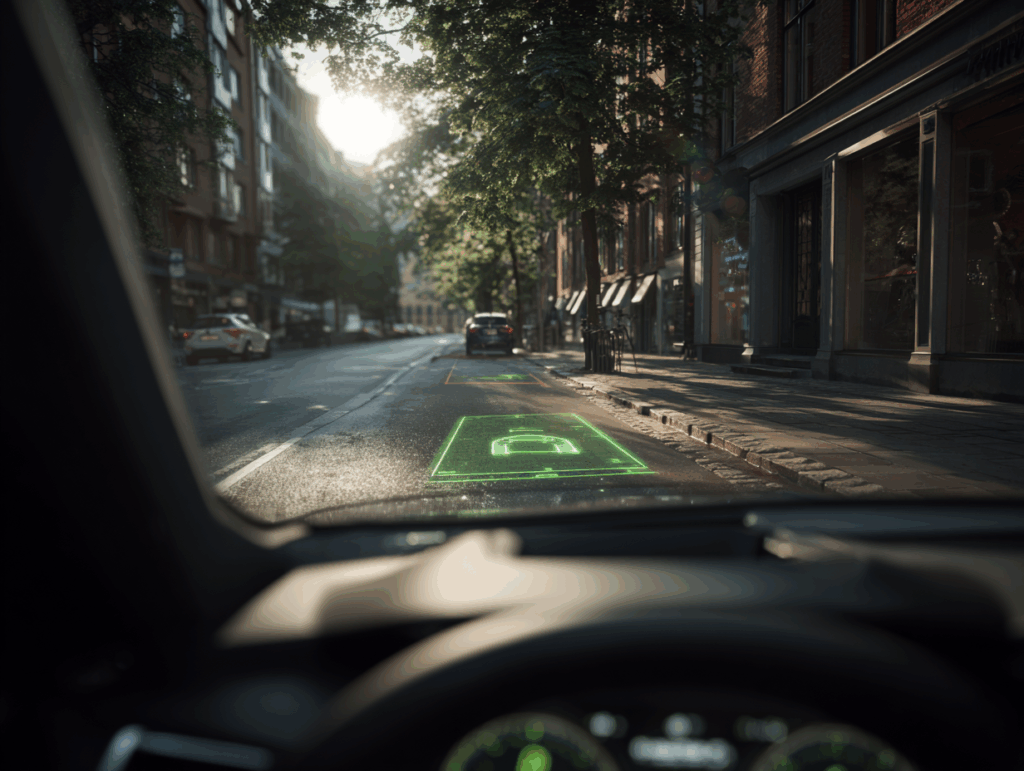
Image created with MidJourney.
AR Parking Feature
Gaming-Inspired Interaction
Virtual parking space detection
╰───⌲
Target acquisition – like locking on to an objective in a game, color-highlighting the free spots when the system detects them
Turn-by-turn routing to a free space
╰───⌲
Guided quest path – using an arrow “marker” that feels like navigating a mission or objective in a game’s map
Color-coded occupancy indicators
╰───⌲
Resource status indicators – like health or resource bars, using green/red markers to show spot availability
Trajectory prediction/
projected driving path
╰───⌲
Trajectory preview – like showing where a character will land in a platformer, projecting the car’s path dynamically
Distance to obstacles
╰───⌲
Proximity meter/warning bar – as in action games when getting too close to danger, showing a meter or bar for obstacle proximity
Surround view + bird’s-eye projection
╰───⌲
Mini-map or radar – displaying a stylized 3D mini‑map or radar view highlighting obstacles and layout from above
Slot boundary visualization
╰───⌲
Level boundaries – showing exact lines/borders like platform edges or map boundaries in games, making spatial judgment easier
User-context-aware assistance
╰───⌲
Adaptive difficulty – like games that scale in difficulty, adjusting how aggressive or gentle the AR guidance is depending on context
Voice & gesture prompts
╰───⌲
Input feedback – responding with subtle animations or sounds when the user gives voice or gesture commands, like confirming an action in a game
Safety alerts
╰───⌲
Alerts with flair – using gentle but noticeable animations (e.g., glowing halo or pulse) when there’s a hazard, like visual cues in games
These features don’t turn parking into a game. Instead, they translate complex spatial judgments into intuitive, visually supported cues that reduce stress and improve confidence.
Emotional AR – the XPeng example
In early 2025, XPeng introduced its Zhuiguang Panoramic AR HUD2 – sometimes dubbed the “Road Rage Reliever”. This projects immersive content across an 87-inch windshield with low latency and high contrast, making graphics appear naturally in the driver’s field of view.
The system allows drivers to trigger animated emojis, such as bananas or expressive faces, that seem to “launch” onto other vehicles, offering a playful way to diffuse stress. Framed as a tool for emotional regulation rather than pure entertainment, the feature reflects a shift from a “tech-first” to an “experience-first” design philosophy, highlighting how AR can address the emotional dimension of driving while balancing engagement and safety.
| Potential | Risks |
| Emotional support – gives drivers a harmless way to manage stress and strong emotions | Distraction – AR objects might take attention away from the road |
| Stress reduction – helps reduce road rage and aggressive driving | Too much gamification – overly playful features could make driving less serious and safe |
| Experience-focused design – prioritizes how drivers feel, not just technical performance | Balance risk – focusing too much on fun might reduce attention to core driving tasks |
Broader context & research
AR-HUD adoption is growing rapidly in China. According to a 2025 industry report, AR‑HUD installations exceeded 900,000 units in 2024, and they’re projected to surpass 1 million in 20253.
On the safety side, recent academic work highlights potential pitfalls: a 2025 on-road study found that higher visual demand from AR tasks reduces drivers’ ability to detect real-world stimuli, especially in their central field of view – a phenomenon linked to inattentional blindness.
What Can We Learn from the Gaming Industry
The gaming industry has spent decades perfecting immersive, engaging, and intuitive experiences. From clear visual hierarchies to reward-driven behaviors, games teach players how to act efficiently and enjoyably in complex virtual worlds. Automotive AR can benefit directly from these lessons by applying them to real-world driving contexts, where safety, attention, and enjoyment intersect. By translating gaming principles into automotive UX, designers can create AR systems that are not only functional but also emotionally engaging and cognitively supportive.
Key lessons from gaming for automotive AR
| Gaming Principle | Automotive AR Application | UX Takeaway |
| Clarity & Information Hierarchy | Show only what matters at the right time; navigation arrows, hazard highlights, and overlays are clear and consistent | In safety-critical contexts, clarity always outweighs visual flair |
| Reward Systems & Motivation | Use progress indicators, positive reinforcement, and subtle feedback for behaviors like eco-driving or parking precision | Encourages safe, attentive behavior through positive coaching rather than competition |
| Multimodal Interaction | Eye tracking, gesture control, haptics, spatial audio | Reduces cognitive load and directs attention efficiently without overwhelming the driver |
| Persistent Digital Worlds | Maintain persistent POIs, memory anchors, and adapt AI to user routines | AR experiences feel consistent, personalized, and contextually intelligent |
| Multiplayer & Shared Context | Enable collaborative AR experiences for passengers, synced POIs, or guided tours | Enhances engagement and social interaction without compromising driver focus |
| Ethical Boundaries & Safety | Clear safe/playful interaction boundaries, opt-in gamification, adaptive personalization | Ensures AR enriches the experience without introducing unnecessary risk |
Applying gaming insights in practice
Rather than blindly copying game mechanics, automotive designers must adapt them to real-world constraints:
- Simplicity first – overloading the HUD with playful elements can distract the driver
- Feedback matters – immediate, subtle cues help drivers correct behavior without stress
- Context-aware design – AR should respond to the driver, environment, and journey context
- Optional engagement – gamified or playful features should be opt-in, respecting driver comfort and skill
The gaming industry offers a rich blueprint for designing AR experiences that are clear, engaging, and cognitively supportive. By borrowing principles already proven here, automotive AR can transform driving from a purely functional task into a more intuitive, enjoyable, and emotionally intelligent experience.
The key is balance: creating playful, immersive interfaces that support rather than compete with real-world driving demands. The future of automotive AR is therefore a controlled blend of fun, utility, and responsibility.
Sources:
- “SEER-VAR: Semantic Egocentric Environment Reasoner for Vehicle Augmented Reality” – Yuzhi Lai, Shenghai Yuan, Peizheng Li, Jun Lou, Andreas Zell – Aug 2025
- “Huawei and Xpeng unite to launch AR-HUD for new Xpeng G7 SUV” – CarNewsChina – June 2025 | “XPeng Launches “Zhuiguang Panoramic” HUD System, Debuting on All-New G7” – ChinaEvHome – June 2025 | “New ‘Mario Kart’ feature in 2025 sedans allows drivers to launch ‘emojis’ at other cars to relieve their road rage” – The Sun US – September 2025 | “Car company creates hilarious tool to channel drivers’ anger — and avoid dangerous road rage incidents” – New York Post – August 2025
- “China Passenger Car HUD Industry Report, 2025” – Market Research, Research In China – July 2025
Author info